Common Tengwar Tattoos

So you want a tattoo in Elvish letters? Good!
First thing: Ignore transcriber tools like that on the Jens Hansen website. I am sorry, and I’m not trying to be edgy or special, but those transcribers have been programmed by people who are not knowledgable enough in these matters to offer such a service - it’s unfortunately as simple as that, and it has resulted in more than enough questionable tattoos already. There are much better tools out there, like Glǽmscribe, which allows for much variation but demands a certain base knowledge, but I believe Tecendil strikes the perfect balance between correctness and accessability, so that it’s always a good place to start - but never forget to still reach out to the larger Tengwar community (for example on Facebook or Reddit) to check for possible mistakes or other suggestions.
But let me give you my own suggestions for some of the most common requests (with detailed description, so that you don’t have to take my word).
Not all those who wander are lost
Without any doubt the tattoo request that I have got the most, literally dozens and dozens of times over the last 25 years, and today usually accompanied by very weird transcriptions taken from TikTok or similar places. I suggest the following:
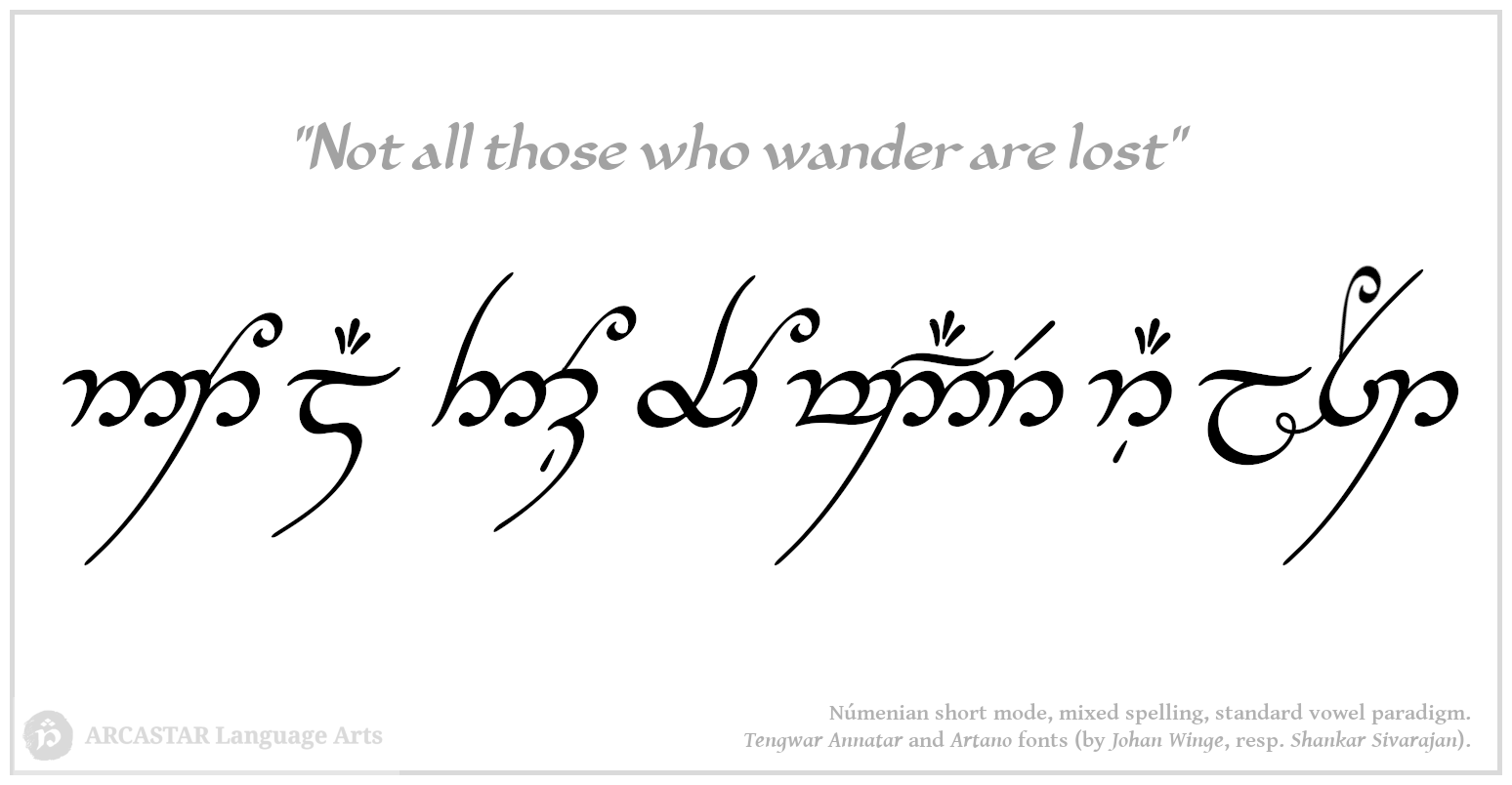
This is written in a spelling method (or “mode”) that tries to come as close as possible to the inscription on the title-page of the LotR, which Tolkien identifies as “what a man of Gondor might have produced, hesitating between the values of the letters familiar in his ‘mode’ and the traditional spelling of English” in the Appendices.
It makes use of a z-letter for the s in “those” (as Tolkien did in “is” and “was”) and marks silent e (as in “herein”). For both occurances of r I use the letter that Tolkien used for those r that are pronounced as vowels in his dialect, even in those places where it would typically be pronounced anyway (at the end of a word when a vowel follows in the beginning of the next word, which we see him do in “war of”). In “lost” I used the regular upright s-letter, even though it made it a bit harder to place the o-sign above it, because Tolkien seems to never have used the upside-down version (that allows you to place vowel signs more easily) in this particular mode (it was reserved for transcription of the letter c, mostly when that is pronounced like s).
The only detail not found in the title-page inscription is the spelling of ll with a single letter, but that is extremely well attested in other sources.
Visually I tried to get as close as possible to the inscription on the One Ring - not because I think it’s the most representative of Tengwar as a whole or because I think it’s particularly beautiful (in fact I don’t think either), but simply because that is the style that most people seem to be interested in for such tattoos. So I made use of two digital fonts: the original Tengwar Annatar font by Johan Winge, as well as its modification Tengwar Artano by Shankar Sivarajan.
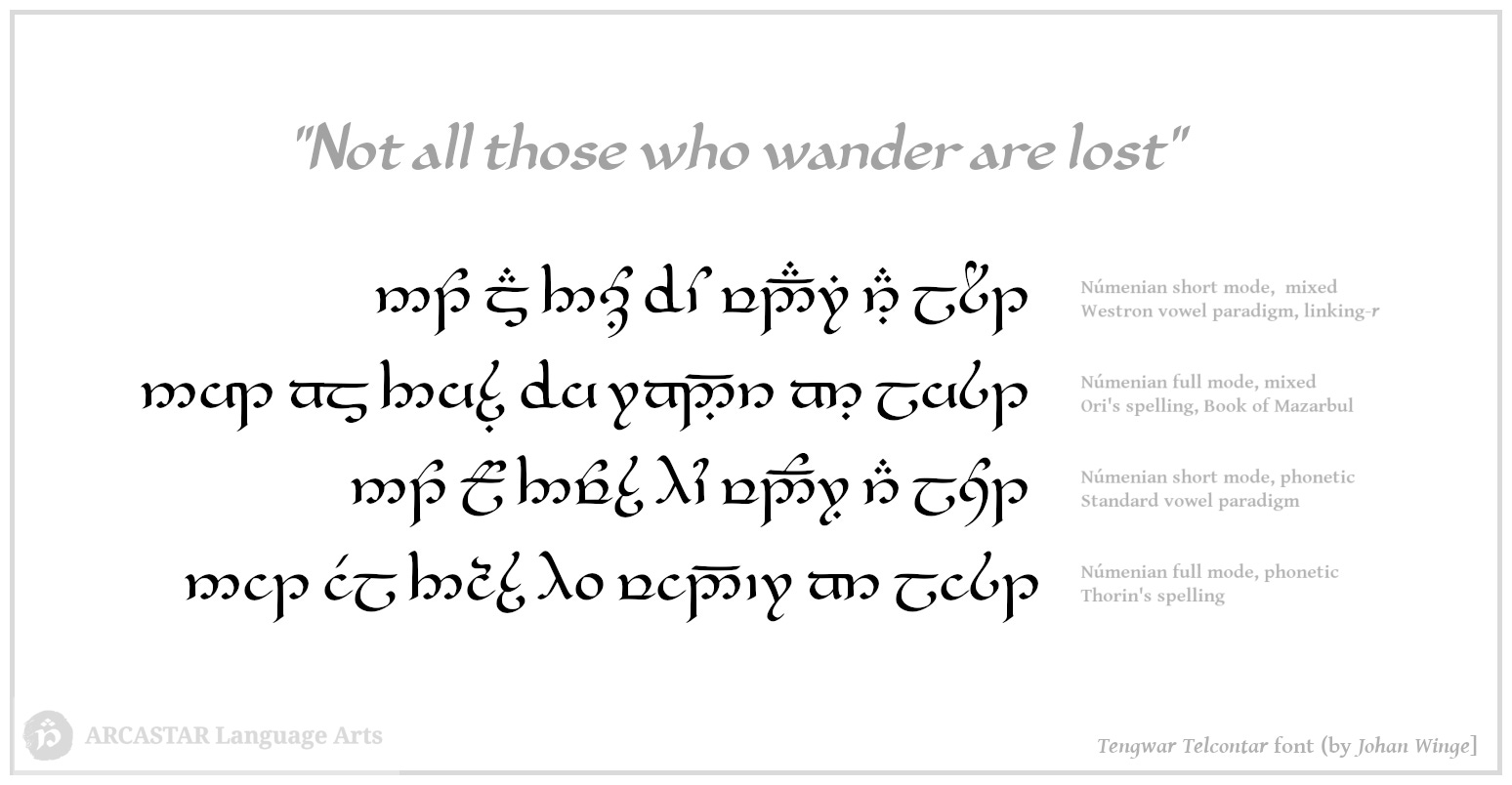
In the chart above I give you (in the more plain formal book-hand) four further possible spellings.
First another very similar spelling, but with the vowel signs for e and i swapped (which is commonly done in Westron spelling and often seen in English texts), and also with the r in “wander” spelt as a full consonant because of the following vowel.
Second is another version of the mixed spelling, but using a full vowel paradigm where vowels are written with tengwar letters just like the consonants. This appears to have been very common among non-Elvish people in the Third Age, and this particular spelling is taken from the Book of Mazarbul, as written by Ori. Note that here the letter for full r is used for w, while the letter for the vocalic r is used for all r indiscriminately.
Third is another short spelling (with vowel diacritics) but applied according to English pronunciation (not a particular actual pronunciation but a more abstract analysis of the Received Pronunciation as it was taught in Tolkien’s time). In Tolkien’s phonetic transcription (which is close to the modern IPA but not identical) it would read: not ōl ðowz hu wondər aṛ lost.
Fourth is the same phonetic analysis applied to full writing. Note that the vowel paradigm is a completely different one from that seen above for mixed spelling. In fact both sets of vowels can be used for both approaches, but this particular one can be seen in the letter (resp. contract) that Thorin wrote to Bilbo.
All we have to decide is what to do with the time that is given us
This also is a very very common request, which often results in people first pointing out, that the original text has “that is given us”, not “that is given to us” as in the Peter Jackson movie. Here’s my suggestion:
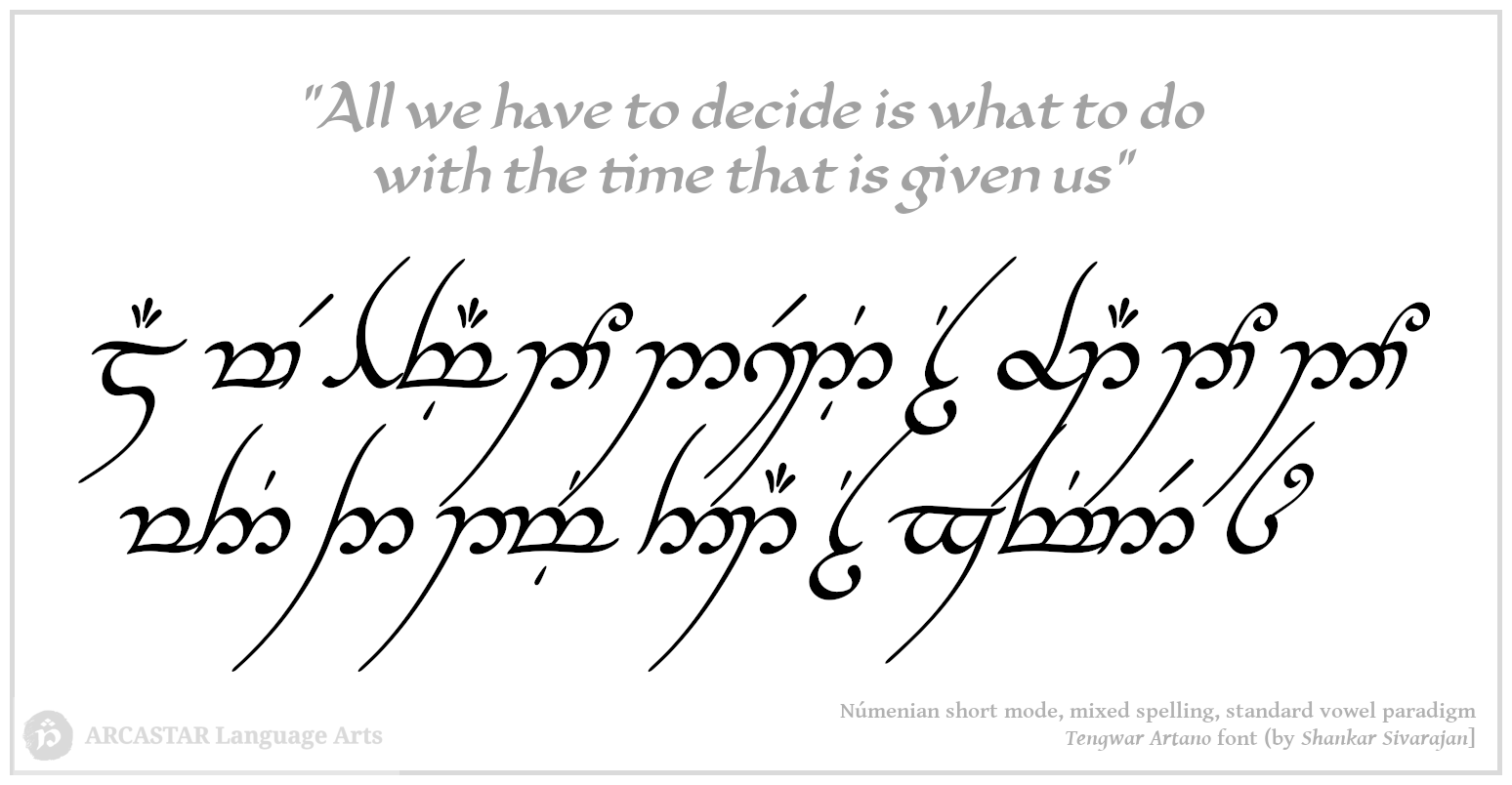
As with the previous one I have given a spelling in accordance with the LotR title-page in the Ring inscription style. Here we have the upside-down s letter used for c in “decide”, which is very important because some transcribers actually spit out a c letter that would explicitely be read as k (and you wouldn’t want “dekide” on your skin, would you?). “The” is spelt with an extended form of the voiced (soft) th letter, as Tolkien did most of the time, and the regular voiced th is also found in “with” - this might not apply to your personal pronunciation, but it is how Tolkien spelt it.
This time I did place the vowel sign on the right side of the s letter (in the word “us”), as the font suggested (I intentionally edited this with the o sign above) because with no consonant following I don’t assume there will be much danger of misinterpreting the placement of the vowel.
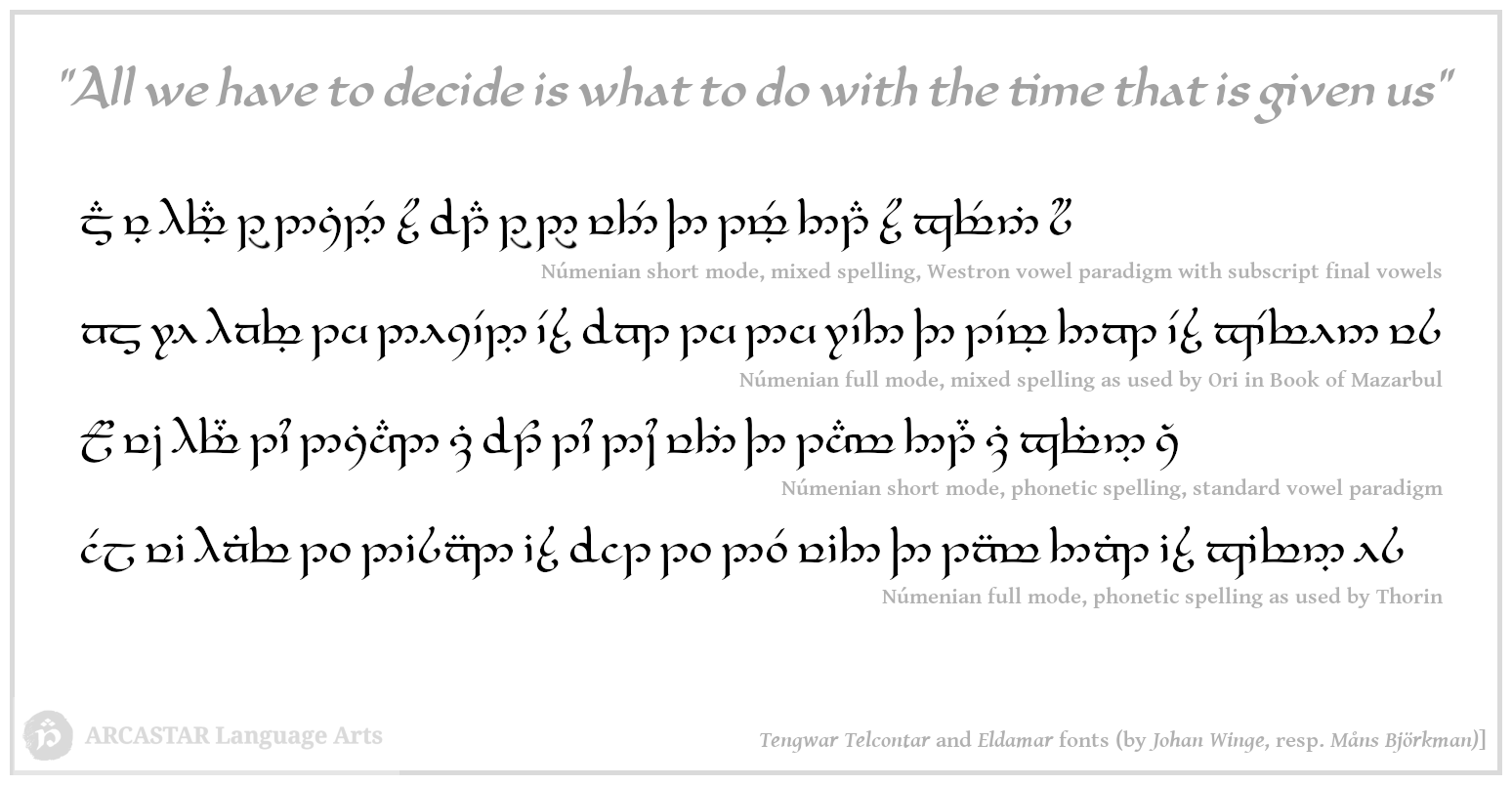
Here we have, again, the same in the four other spelling varieties introduced above. The first one, the mixed short mode with the Westron vowel paradigm, this time also makes use of the possibility to place an upside-down version of the vowel signs below the consonant for final vowels, simply because we’ve got so many in this phrase.
In the phonetic versions we now find more of the different vowels, and we also find some intrusion of my personal biases in that I wrote “to” with a short vowel and “do” with a long one, although you might think that both are identical, or that “to” should on the contrary be reduced to a mere murmur (schwa), and you might also notice that in the phonetic short I wrote “we” with a long vowel, while in the phonetic full I used a short one - these decisions cannot be avoiced when writing phonetically, and I intentionally showed my hesitation. What I actually transcribed is this:
ōl wi(/wī) hæv tu disai̯d iz ƕot tu dū wið ð tai̯m ðæt iz givən ʌs.
Aurë entuluva
The third most common request I have myself seen is the only one that isn’t in English. This is “day shall come again” in Quenya, as famously exclaimed by Húrin 70 times.
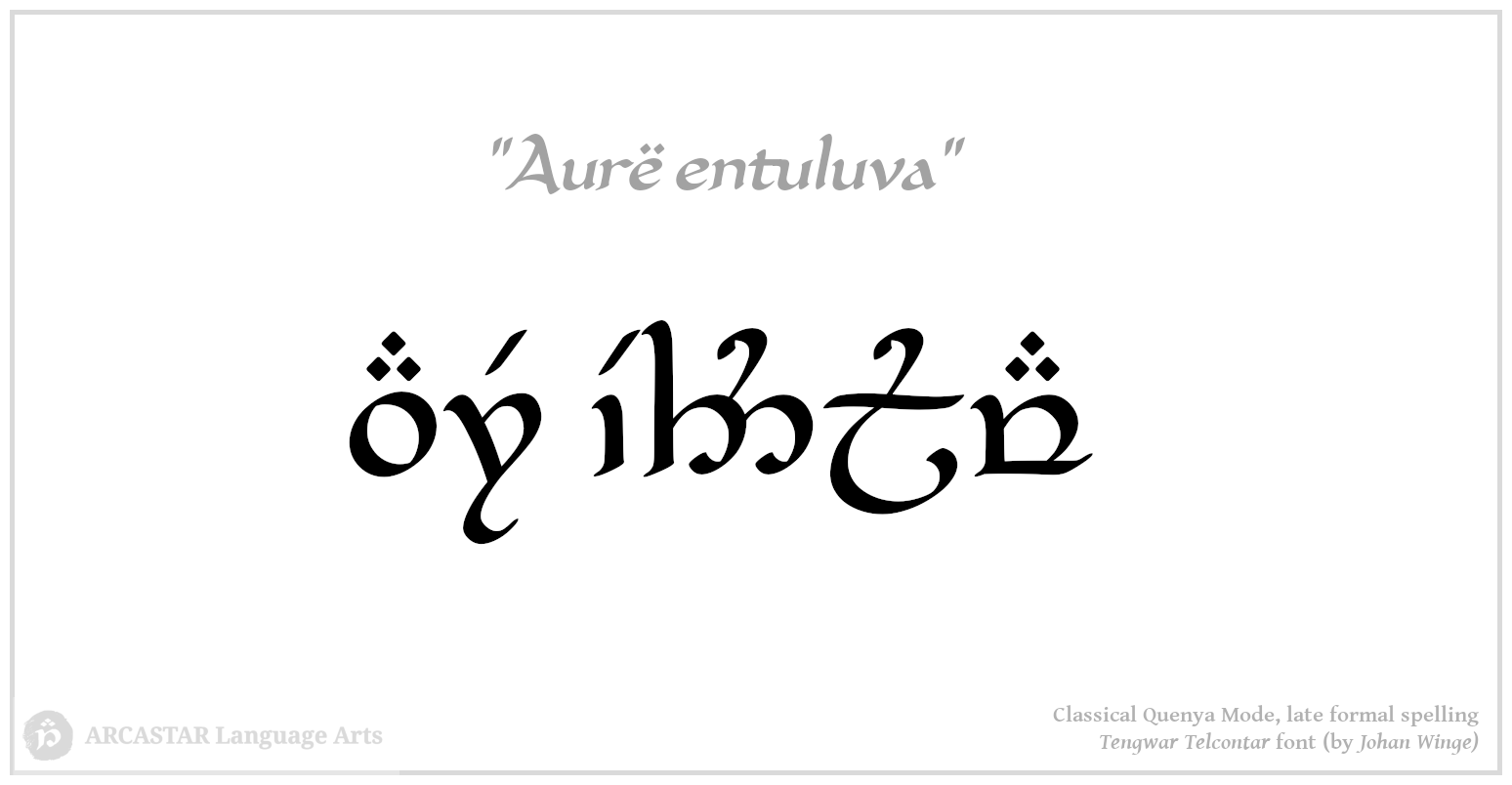
For this I have chosen not to give a style immitating the One Ring, since there is really no connotation to the much later ring business, and I have also noted that people who are interested in this particular phrase are less interested in this style - being a phrase from the Silmarillion this might not be too surprising, since those who have read this book are often a bit less focused on things that are explicitely related to the LotR as such (no judgment intended).
Spelling-wise this is the formal version of the Classical Mode (that is only used for Quenya) as Tolkien showed it to us in his “Namárie” calligraphy in The Road Goes Ever On. The consonants are thus a bit different and the vowel diacritics are read after the consonants.
The only exception is au, a diphthong, i.e. two vowels in only one syllable. These can (and typically are) expressed as a unit (a vowel diacritic placed upon a semi-vowel letter), even though this does, strictly speaking, break the reading order.
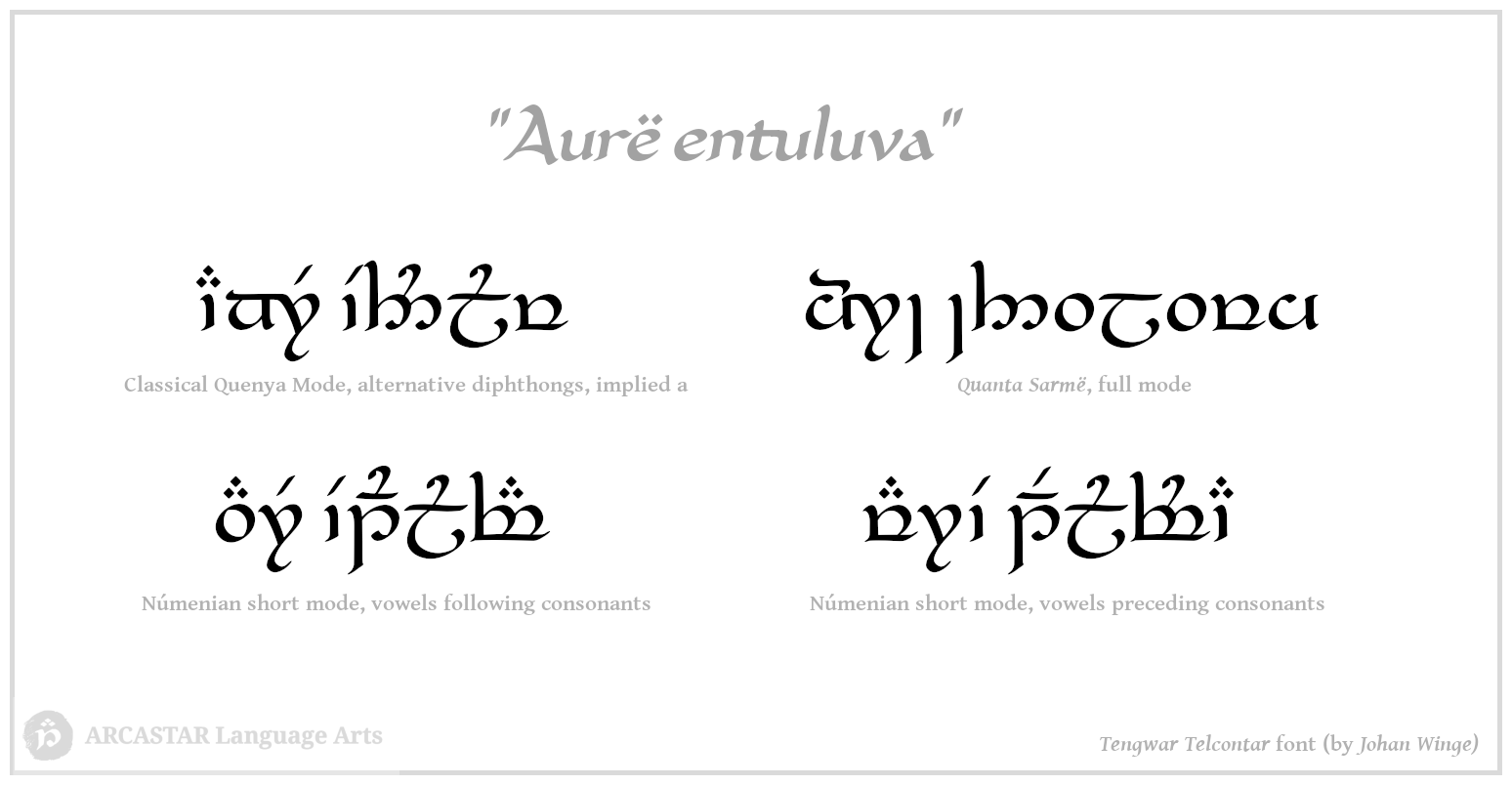
For this also I wanted to offer some more variety and chose four other methods of spelling:
First we have a different approach to the Classical Mode, in which the vowel a need not be spelt out but can be implied from bare consonant letters by context (hence what looks like entuluv is actually still entuluva. Often consonants that are actually bare have a dot placed underneath, but I chose not to do so, because the original samples I was emulating also don’t, and native speakers certainly understand the words from context. Here I also spelt au out with the regular letter for the semi-vowel form of u, upon which the a diacritic must not be set because aurë would indeed read warë then (this spelling of this word is explicitely attested).
Next to that we have a full spelling variety of that same mode, called quanta sarmë in Quenya. It is said that this spelling was favoured by Fëanor and other scholars for reasons of linguistic analysis.
In the bottom left we have a Númenian spelling, i.e. the general use of the Third Age as seen above for English, employed here for Quenya. Here the vowel order remained the same as in Classical mode, and as far as we know the same spelling for au can be used.
Finally in the bottom right we have practically the same Númenian spelling as seen above for English, including the vowel order (and hence the au spelling). Given that this is almost the same variety as seen in the Oath of Elendil calligraphy on Tolkien’s artwork for RotK (only that this has the signs for o and u swapped) I assume that this would be a common spelling in Gondor.
Suggestions?
A couple more do come to mind. Many seem interested in things like Eowyn’s “I am no man”, or movie quotes like “po-ta-toes!”, but I think this is long enough as it is already. Feel free to contact not only the places suggested above but also me personally if you’re interested. Maybe there can be a second part to this at some point?
Hey, @Arcastar Language Arts! I’m also interested in the correct spelling of the phrase “Even darkness must pass. A new day will come.”
Is this the correct one? What do you think? https://www.reddit.com/r/Tengwar/comments/1pyhxtr/translation_for_tattoo/
Thanks in advance!
Ouu, I love this. What about ‘even the darkness must pass’? I see much arguments about this one, would love to see the proper transliteration (in the artano font, too?)
Ty!